
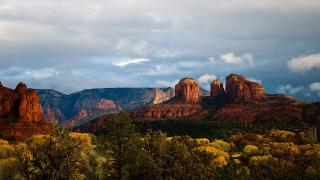

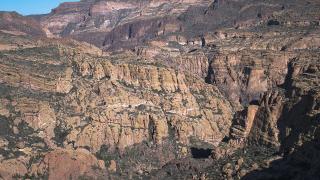

One day in Tucson can cover two very different things: the Sonoran Desert, which surrounds the city on every side, and the Spanish and O'odham history at its core. This plan starts west of town, in the hills where the Arizona-Sonora Desert Museum and the western half of Saguaro National Park sit next to each other. It then drives south to Mission San Xavier del Bac, an 18th-century church that is still a working parish. It ends downtown on the site of the 1775 Spanish fort, with sunset from the peak that overlooks it.
You need a car. The four areas are 2–25 miles apart, and the driving adds up to about 50 miles and under two hours. The walking is light, about 5 km in total, most of it on the museum's paths. The order is set by three clocks. The museum's bird show starts at 10:30, the mission church closes at 16:00 and the road up Sentinel Peak closes at sunset.
 The Red Hills Visitor Center sign in Saguaro National Park, west of Tucson. Image: naturenps, Public domain, via Wikimedia Commons.
Before you go. No stop on this route needs a timed booking, but three things are worth sorting out in advance.
- Arizona-Sonora Desert Museum: buy tickets online at desertmuseum.org to skip the ticket line. In 2026 admission costs $29.95 for ages 13–64 and $24.95 for ages 3–12.
- Saguaro National Park: entry costs $25 per private vehicle (2026), and the park does not accept cash. Pay by card at the Red Hills Visitor Center or at the fee machine outside it.
- Check the day of the week. The museum's free-flight bird show runs only Thursday to Monday. On Mondays the road up Sentinel Peak is closed to cars.
08:30: Arizona-Sonora Desert Museum at opening
The Arizona-Sonora Desert Museum, at 2021 N. Kinney Road, is open every day of the year. From October to May its hours are 8:30–17:00. In summer (June to September) it opens at 7:30 and closes at 16:00. Despite its name, it is mostly outdoors. The museum says 85 percent of it is outdoors, and that a visit is mainly a walk through the desert.
The Hummingbird Aviary and the large walk-through aviary hold birds native to the region. The desert grassland section has prairie dogs. A replica limestone cave explains the region's geology and shows minerals from the collection. Rivers to the Sea is two galleries of freshwater fish and sea life from the Gulf of California. The Desert Loop Trail gets you out among the plants. The museum's own advice is to allow at least two hours, and that is the minimum.
 The entrance to the Arizona-Sonora Desert Museum on Kinney Road. Image: Anna Irene from Frankfurt, Deutschland, CC BY-SA 2.0, via Wikimedia Commons.
 A hummingbird in the museum's walk-through hummingbird aviary. Image: Puchku, CC BY-SA 3.0, via Wikimedia Commons.
10:30: Raptor Free Flight. From 12 November 2026 to 29 March 2027, the museum flies birds of prey loose over the open desert. The show runs Thursday to Monday at 10:30, weather permitting. It is not daily, and it no longer runs at 10:00 and 14:00 as older guides say. The museum asks visitors to arrive 20 minutes early to walk to the demonstration area. A narrator explains each bird. One of the species shown is the only raptor in the world that hunts as a family, which the museum compares to wolves. The museum warns that no particular bird is guaranteed to fly on any given day.
 A Harris's hawk in flight at the Arizona-Sonora Desert Museum. Image: Jöshua Barnett, CC BY 2.0, via Wikimedia Commons.
If you are here on a Tuesday or Wednesday, or outside the show season, spend that half-hour with the mammals instead.
 A Mexican gray wolf in its enclosure at the Desert Museum. Image: HarmonyonPlanetEarth, CC BY 2.0, via Wikimedia Commons.
Lunch on site. The museum runs its own cafés. Ironwood Terraces serves lunch daily from 11:00 to 14:00, and there is also the Ocotillo Café and a coffee bar. Eat before you leave at about 11:45.
11:45: Saguaro National Park, Tucson Mountain District
Drive one mile north on Kinney Road from the museum. At the junction with Mile Wide Road you enter Saguaro National Park's Tucson Mountain District, the park's western half. The Red Hills Visitor Center is one mile further on, at 2700 N. Kinney Road. It is open 9:00–17:00 from October to May, with water on the patio and restrooms outside. Pay the entrance fee here, by card. If you plan to visit Saguaro's eastern district too, the $45 annual Saguaro pass is valid in both.
Then drive the Bajada Loop Drive. It is a 6-mile loop of graded dirt road with pullouts, picnic areas and trailheads, and the park says it needs no high-clearance vehicle. Its entrance is at Hohokam Road, about 1.6 miles west of the visitor centre on Kinney Road. Vehicles wider than 8.5 feet, or longer than 40 feet including a trailer, are not allowed.
 The Red Hills Visitor Center, with saguaros on the hills behind. Image: Scott Edmunds, CC BY 2.0, via Wikimedia Commons.
Stop at the Signal Hill Picnic Area. Signal Hill is the petroglyph site the park features on its rock-art page. Petroglyphs are designs pecked, cut or scraped into rock, and their makers preferred the dark coating of desert varnish, which exposes lighter stone underneath. The park says most rock art in Saguaro appears to date from the Hohokam period. The Hohokam were farmers, gatherers and hunters who lived in southern Arizona's river valleys and deserts from about AD 300 to 1450. Spirals are common in Hohokam rock art, along with geometric shapes and stylised people, mountain sheep and deer. Do not touch the carvings.
 Hohokam petroglyphs on the boulders of Signal Hill. Image: National Park Service Digital Image Archives, Public domain, via Wikimedia Commons.
The loop comes out where Golden Gate Road meets Sandario Road. Allow about 1 hour 15 minutes for the loop and Signal Hill together. Then turn south for the mission. The drive is about 25 miles and 45 minutes.
In summer the park advises keeping outdoor activity to before 10:00 or after 16:00. If you come between June and September, reverse the morning. Do the loop at 8:00, then spend the hottest hours at the museum, which opens at 7:30 in those months.
14:00: Mission San Xavier del Bac
Mission San Xavier del Bac stands about 10 miles south of downtown, at 1950 W. San Xavier Road. The church is in the community of Wa:k, in the San Xavier District of the Tohono O'odham Nation. It is a National Historic Landmark and an active parish church. Its caretakers describe it as a hub of spiritual, educational and social life for the descendants of the O'odham people for whom the mission was founded.
The history is set out by the Patronato San Xavier, the non-profit that looks after the building. The Jesuit missionary Eusebio Francisco Kino first came to Wa:k in 1692 and placed the village under the patronage of St Francis Xavier. The present church was begun in 1783 under Father Juan Bautista Velderrain, a Basque Franciscan. To pay an architect from Mexico, Ignacio Gaona, and a large O'odham workforce, Velderrain borrowed money from a Sonoran rancher against wheat crops that had not yet been planted. Work stopped in 1797, when the money ran out. The result is one of the finest examples of Mexican baroque architecture in the United States. The first, smaller church of 1756 survives as the building's east wing.
Visiting. The church is open 9:00–16:00 every day, holidays included, and so are the museum and the mausoleum. The gift shop opens 8:00–17:00. The Patronato runs free docent tours of about 30 minutes, with donations welcome. No booking is needed. Tours run Monday to Friday and, when possible, on Saturdays. They cover the grounds only, because the parish keeps the church interior as a place of worship. Visit the church on your own before or after. Tours are cancelled when the temperature passes 95°F.
Two other points. The church has no heating or air conditioning, so dress for the weather. The parish states that the mission is on tribal land and follows tribal regulations, and the Patronato notes that the parish wants the church kept as a sacred space for worshippers. Check Mass times with the parish office on (520) 294-2624. The Patronato is conserving the carved façade over several winters, so you may find scaffolding over part of the front.
Allow 1 hour. Then drive north to downtown, about 10 miles and 20 minutes.
15:20: Downtown on the Turquoise Trail
In 1775 the Spanish built a fort here, the Presidio San Agustín del Tucsón. The Presidio San Agustín del Tucsón Museum at 196 N. Court Avenue is a re-creation of it. You go in through an 1860s Sonoran row house, and the grounds include the remains of a pit house about 2,000 years old. Adult entry is $9, and $6 for ages 6–13.
Check the museum's hours before you count on it. From 1 October to 30 April it is open Tuesday to Sunday from 10:00 to 16:00, with last admission at 15:30, and it is closed on Mondays. Arriving at about 15:20 leaves time only for a quick look. If the museum matters to you, swap the order: go downtown in the morning and see the desert in the afternoon.
 The reconstructed adobe wall of the Presidio San Agustín del Tucsón Museum. Image: Richard N Horne, CC BY-SA 4.0, via Wikimedia Commons.
Whether or not the museum is open, you can walk the Turquoise Trail. A turquoise line painted on the pavement marks a 2.5-mile loop of historic downtown buildings, starting from the Presidio Museum. A paper map costs $2 at the Presidio or at the visitor centre in the Pima County Historic Court House, and a $5 app gives an audio guide. With the light going, do part of it. The museum also describes a shorter 2-mile version that turns back north up Church Avenue.
 The tiled dome of the Pima County Historic Court House, on the Turquoise Trail. Image: Michael Barera, CC BY-SA 4.0, via Wikimedia Commons.
16:45: Sunset from Sentinel Peak
Sentinel Peak is the 2,900-foot hill just west of downtown, about 3 miles and 10 minutes by car from the Presidio. It is known as "A" Mountain after the large stone "A" on its side, which University of Arizona students built in 1915. The city notes that the hill was a lookout for the area's early Indian and Spanish settlers. Sunset in mid-November is at about 17:25, and in mid-December at about 17:20.
 The "A" on the side of Sentinel Peak, just west of downtown Tucson. Image: Bill Morrow, CC BY 2.0, via Wikimedia Commons.
Car access is limited. The park is open from sunrise to sunset, but cars may drive up only from 14:00 to sunset on Tuesday to Thursday, and from 11:00 to sunset on Friday to Sunday. On Mondays the road is closed to vehicles. Because the road closes at sunset, watch the light go from the top and then drive straight down. On a Monday, end the day on the Turquoise Trail instead.
 Downtown Tucson and the mountains beyond, from Sentinel Peak. Image: John Diebolt, CC0, via Wikimedia Commons.
For dinner, downtown is a few minutes away.
The alternative: Sabino Canyon instead of the west side
If you would rather walk in a canyon than drive a desert loop, swap the museum and Saguaro West for Sabino Canyon, a US Forest Service recreation area. It is about 15 miles and 30 minutes by car from downtown. The Sabino Canyon Crawler, an electric shuttle that seats up to 48, runs a narrated trip up the 3.7-mile Sabino Canyon road and back, with a five-minute stop at the top. Fares are $15 for adults and $8 for ages 3–12, and children under 3 ride free. Buy tickets online; the only cash sales are for exact fares through a concierge on site.
Arrive 15 minutes before your departure, and in busy season allow 30 minutes more for parking, because the shuttles do not wait. After rain the Crawler runs a shorter high-water tour. You can get off at any stop and walk back down to the visitor centre. The separate Bear Canyon shuttle ($8 adults) cuts the walk to Seven Falls to 2.7 miles each way. Private cars also pay the recreation area's $8 amenity fee, sold at the car-park entrance. The visitor centre is at 5700 N. Sabino Canyon Road. Keep San Xavier and the Sentinel Peak sunset in the afternoon.
 Sabino Canyon, with saguaros on its slopes. Image: Lee Adlaf from Birmingham, AL, USA, CC BY 2.0, via Wikimedia Commons.
The day at a glance
| Time | Stop | Allow | Book ahead? |
|---|---|---|---|
| 08:30 | Arizona-Sonora Desert Museum | 3 h | Online tickets save queuing |
| 10:30 | Raptor Free Flight (Thu–Mon, 12 Nov–29 Mar) | 30 min | No, included |
| 11:15 | Lunch at the museum | 30 min | No |
| 11:45 | Saguaro NP West: Red Hills, Bajada Loop, Signal Hill | 1 h 30 min | No, card only |
| 14:00 | Mission San Xavier del Bac | 1 h | No (free) |
| 15:20 | Presidio and the Turquoise Trail | 1 h 10 min | Museum last entry 15:30, closed Mon |
| 16:45 | Sentinel Peak at sunset | 45 min | No (no cars on Mondays) |
Practical notes
Driving. The route is about 50 miles of driving. Kinney Road links the museum and Saguaro West. Arizona does not use daylight saving time, so sunset in Tucson moves from about 17:20 in December to 18:30 in mid-March.
Heat. From June to September, Saguaro's winter days in the 50s to 70s °F give way to highs from the mid-90s to above 110°F. Late summer brings monsoon storms and the risk of flash floods. In those months, start at dawn, carry water and keep the middle of the day for indoor exhibits.
Holidays. The Desert Museum is open 365 days a year, and the mission church is open every day, holidays included. The Presidio Museum closes on Thanksgiving and the day after, on 24–25 December, on 1 January and at Easter.
Respect. At the petroglyphs and at San Xavier you are on sites that matter to living communities. Leave the rock art untouched, and treat the mission as a church first.
Prices are as published by each site in November 2026. Check them before you go.


