
Flagstaff sits at about 7,000 feet in a ponderosa pine forest, below the San Francisco Peaks. Within an hour's drive of downtown are three national monuments: cliff dwellings in a limestone canyon, a volcano that erupted around the year 1085, and the pueblos people built in the century after it. This plan covers all three in daylight, the Museum of Northern Arizona in the late afternoon, and the 1880s railroad town at dusk. It finishes at Lowell Observatory, where Pluto was discovered, looking through a 19th-century telescope after dark.
You need a car. The route is about 100 miles, about 40 of them on the loop road through Sunset Crater and Wupatki, and about three hours of driving. Walking adds up to about 4 miles, with one real climb, the stairs of the Island Trail at Walnut Canyon. The order is set by the clock: Walnut Canyon opens at 9:00, the museum's last admission is 16:00, the sun sets at about 17:15–17:50 from November to January, and the Clark Telescope is open from dusk to 21:30.
 Snow on the San Francisco Peaks, north of Flagstaff, in November. Image: US Forestry Service/Deborah Lee Soltesz, Public domain, via Wikimedia Commons.
Before you go. No stop on this route needs a timed booking, but four things are worth sorting out in advance.
- Pay national monument fees by card. Walnut Canyon charges $25 per private vehicle. A second $25 vehicle pass covers both Sunset Crater Volcano and Wupatki for 1–7 days. US citizens and residents can buy a $45 Flagstaff-area annual pass that covers all three. The NPS fee desks take cards only; the park stores sell some passes for cash, but only while they have stock.
- Lowell Observatory: adults (18+) $35, seniors (55+) $30, ages 6–17 $20, under 5 free (November 2026). A ticket is valid all day with re-entry. It is sold on site until 21:00 and at lowell.edu.
- Museum of Northern Arizona: online tickets are recommended and are final (no refunds). See musnaz.org.
- Check the day. Lowell Observatory is closed on Tuesdays. NPS has also listed the Wupatki visitor center as closed on Tuesdays from 3 November 2026 to 2 March 2027; call (928) 679-2365 to confirm before a Tuesday visit. On a Tuesday, use the alternative at the end of the Lowell section.
09:00: Walnut Canyon, cliff dwellings below the rim
Start at Walnut Canyon National Monument, about 7.5 miles east of Flagstaff. Take Interstate 40 to Exit 204 and follow the 3-mile road south to the visitor center. From downtown the drive is about 12 miles and 20 minutes. The park opens at 9:00 and closes at 17:00 (13:00 on Thanksgiving), and it is closed on 25 December and 1 January. Outside those hours you cannot reach the trails or the viewpoints, so an early-morning or sunset visit is not possible.
Walnut Creek cut the canyon over about 60 million years. Inside the park it is about a quarter-mile wide and up to 400 feet deep. The National Park Service calls the people who lived here the Sinagua, from the old Spanish name for the region, Sierra de Sin Agua, "mountains without water." They farmed corn, squash and beans on the rim for centuries. In the 1100s many families moved into the shallow alcoves that had weathered out of the limestone below the rim, and walled them into rooms. The community lasted another 150 years or so before the people moved on. After the railroad arrived in the 1880s, souvenir hunters dug through the dwellings with shovels and dynamite, which led to the national monument in 1915.
 Sinagua cliff-dwelling rooms built into a limestone alcove on the Island Trail. Image: Daniel Schwen, CC BY-SA 3.0, via Wikimedia Commons.
The Island Trail is the reason to come. It is a paved, 1-mile round trip that drops 185 vertical feet down stairs, loops past 25 cliff-dwelling rooms, and climbs back the same way. More dwellings are visible across the canyon. NPS allows about an hour and rates it strenuous, especially if you have just arrived at 7,000 feet. Some sections have steep drop-offs and no handrails. The park says most children, even pre-schoolers, manage it well, but keep them close. Do not climb on or lean against the walls. Entry to the trail closes at 16:00.
 The paved Island Trail runs along the canyon wall beneath limestone overhangs. Image: Photograph by Mike Peel (www.mikepeel.net)., CC BY-SA 4.0, via Wikimedia Commons.
In winter, check first. NPS warns that the Island Trail may be closed in winter when it is snowy or icy. Check the park's alerts or call (928) 526-3367 before you set off. If the Island Trail is closed, or you are uneasy with heights, walk the Rim Trail instead. It is an easy, fairly level 0.7-mile round trip of about 30 minutes, with two overlooks onto the cliff dwellings and a partly rebuilt pithouse and pueblo back from the rim. Its first stretch is paved and accessible.
Allow 1 hour 30 minutes. Pay the $25 vehicle fee by card at the visitor center. Then drive back west on I-40, take US 89 north, and turn right at the sign for Sunset Crater Volcano and Wupatki. The drive is about 21 miles and 35 minutes.
11:05: Sunset Crater Volcano and the Lava Flow Trail
Sunset Crater Volcano National Monument protects the youngest volcano in the San Francisco Volcanic Field, one of roughly 600 volcanoes in northern Arizona. It erupted around the year 1085, for a few weeks or months. The eruption buried homes in ash and cinders, forced the people living here to move, and is still remembered in the stories of their descendants. The cinder cone's vent stands about 1,000 feet above the surrounding land. Cinder cones usually erupt only once, so Sunset Crater is not considered active, though the volcanic field is.
 Sunset Crater from the air, with the dark Bonito Lava Flow at its base. Image: National Park Service, Public domain, via Wikimedia Commons.
You cannot climb the cone. The trail to the top was closed in 1973. By then thousands of hikers had worn waist-deep trenches into the loose cinders, and the scars are still visible. Instead, walk the Lava Flow Trail, a 1-mile loop across the Bonito Lava Flow at the foot of the volcano that takes about an hour. NPS rates it easy. The upper quarter-mile loop is paved and accessible, and pets are allowed on the paved part only. The Lenox Crater Trail up a neighbouring cinder cone (1.6 miles round trip, moderately strenuous) adds about 1 hour 30 minutes.
 Rough basalt of the Bonito Lava Flow, with cinder cones behind. Image: Shepard4711, CC BY 2.0, via Wikimedia Commons.
Stop first at the visitor center, open 9:00–16:30 daily except Thanksgiving, Christmas and New Year's Day. Buy the $25 vehicle pass there, by card; it also covers Wupatki. There is a bottle-filling station. The loop road and trails are open around the clock, but NPS warns of occasional closures for winter weather and says snow, ice and freezing temperatures are common in winter. The monument is above 7,000 feet, so bring a warm layer even on a sunny day.
Allow 1 hour 15 minutes. Then continue north on the paved loop road (Forest Road 545). It drops from pine forest into open juniper grassland and then into the red rock of the Wupatki basin. Wupatki's visitor center is about 19 miles and 40 minutes on.
13:00: Wupatki, the pueblos built after the eruption
Wupatki National Monument lies lower than Flagstaff, between 4,280 and 5,720 feet. Its pueblos were occupied from the early 1100s to the mid-1200s, in the century and a half after Sunset Crater erupted. Thirteen tribes are traditionally associated with the monument. NPS notes that descendant communities believe the people who lived and died here remain as spiritual guardians. These places are remembered and cared for, not abandoned, so stay on the trails and leave everything as you find it.
Wukoki Pueblo is on a short spur road about 2.5 miles from the visitor center. It is an eight-room pueblo built on top of a sandstone outcrop, and its tower once stood three storeys high and still holds original roof beams. The trail is 0.2 miles round trip and takes about 15 minutes.
 Wukoki Pueblo on its sandstone outcrop in the Wupatki basin. Image: sunfishtommy, CC0, via Wikimedia Commons.
Wupatki Pueblo is directly behind the visitor center. It has 104 rooms, a large community room and a ballcourt. NPS calls it the largest free-standing pueblo in northern Arizona. An accessible path leads a few hundred feet to an overlook of the whole site. A 0.5-mile round-trip trail continues around it to the ballcourt and a natural blowhole at the far end. The park store sells a $2 trail guide that follows the numbered stops.
 Wupatki Pueblo, the largest free-standing pueblo in northern Arizona, from the trail. Image: NPS photo, Public domain, via Wikimedia Commons.
Lunch. None of the three monuments has a restaurant or café (the park stores sell only snacks and bottled water), so buy a picnic in Flagstaff. Wupatki Pueblo has picnic tables, a bottle-filling station and flush toilets.
The Wupatki visitor center is open 9:00–16:30 and closed on Thanksgiving, 25 December and 1 January. NPS has also listed it as closed on Tuesdays from 3 November 2026 to 2 March 2027; call (928) 679-2365 to check. NPS says the trails and pueblos are open from sunrise to sunset all year.
Allow about 1 hour 15 minutes, including Wukoki and lunch, and leave by about 14:15. On a short winter day, drive back the way you came rather than continuing north past Citadel and Lomaki pueblos. NPS puts the drive from the Wupatki visitor center to Flagstaff at 45–60 minutes, and warns that GPS is often unreliable here: do not follow it onto unpaved forest roads.
15:25: Museum of Northern Arizona
The Museum of Northern Arizona is on Fort Valley Road (US 180) on the northern edge of town, the road to the Grand Canyon. It was founded in 1928 and is a private non-profit. Its exhibit building, built of the local lava rock during the Depression, opened in 1936. Its galleries cover the Colorado Plateau: its Native peoples, archaeology, pottery, jewellery, geology and life zones. The Geology Gallery has a cast skeleton of Dilophosaurus, a meat-eating dinosaur that lived in northern Arizona about 200 million years ago. Its archaeology and Native peoples galleries cover the same plateau as the morning's monuments.
 The lava-rock entrance of the Museum of Northern Arizona, opened in 1936. Image: Nathan Strait, CC BY-SA 4.0, via Wikimedia Commons.
The museum is open daily 10:00–17:00. Last admission is at 16:00, and on-site tickets are sold until one hour before closing. Online tickets must be redeemed by 16:00 on the day of your visit. Admission costs $18, $16 for seniors 65+, $13 for Native Americans and for ages 10–17, and is free for children 9 and under (2026). It is closed on New Year's Day, Thanksgiving, and 24 and 25 December. Among the exhibitions on view in November 2026 is Wagon Road to Mother Road, on the route that became Route 66.
Allow 1 hour 30 minutes. If you run late at Wupatki, this is the stop to shorten. Then drive about 3 miles and 7 minutes into downtown.
Alternative: Riordan Mansion. If you prefer houses to galleries, Riordan Mansion State Historic Park is near the university. It was built in 1904 for two Riordan families. It is a 40-room Arts and Crafts house of log-slab siding and volcanic stone. In winter, guided tours run on the hour from 11:00 to 16:00, places are limited and booking is recommended. The guided tour of the interior costs $18 for adults (14+) and $12 for ages 7–13, and includes park entry; the $5 grounds-only entry does not include the house.
17:00: Downtown Flagstaff at dusk
Downtown grew around the railroad. The Atlantic and Pacific Railroad reached Flagstaff on 1 August 1882, and the town quickly became the largest stop on the line between Albuquerque and the California coast. Route 66 later brought a rise in tourism by car, especially after the Second World War. The highway turns 100 on 11 November 2026, and the visitor center marks it with a celebration from 10:00 to 14:00 that day.
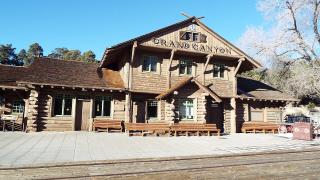
Start at the train station at 1 E. Route 66. It was built in 1926 in Tudor Revival style, with half-timbering, tall chimneys and steep cross-gables, to replace the older depot a block east. Amtrak trains still stop here. The west end houses the Flagstaff Visitor Center, with a model railroad of the town in the 1920s. It is open Monday to Saturday 8:00–17:00 and Sunday 9:00–16:00, so it may be closing as you arrive.
 The 1926 Tudor Revival train station on Route 66, now the Flagstaff Visitor Center and Amtrak stop. Image: Volker Schmidt, CC0, via Wikimedia Commons.
From the station, walk north across Route 66 into the grid of old blocks. The Babbitt Brothers Building, on the corner of Aspen Avenue and San Francisco Street, was built in 1888 by David Babbitt, one of five Babbitt siblings who arrived from Cincinnati in 1886 to run cattle and trading businesses. Built of local Moenkopi sandstone, it was Flagstaff's first two-storey building, and the family ran a department store in it until 1987. Look for the old painted sign on its south wall: "Babbitt Brothers Ranchers, Merchants & Indian Traders." The Orpheum Theater stands on the site of an opera house that collapsed under more than five feet of snow on New Year's Day 1915. Heritage Square was created in the 1990s revival of downtown. The city's free Historic Downtown Walking Guide numbers the stops.
Sunset in Flagstaff is at about 17:20 in mid-November, 17:15 in mid-December and 17:35 in mid-January. Arizona does not use daylight saving time. Have dinner downtown. Lowell Observatory is about 1.5 miles and 5 minutes away by car, up Mars Hill at the west end of town.
19:00: Lowell Observatory after dark
Percival Lowell, a Boston astronomer who hoped to find life on Mars, founded the observatory on Mars Hill in 1894. In 1930 Clyde Tombaugh found Pluto on photographic plates taken here. In the 1960s the observatory's Clark Telescope was used to map the Moon for the Apollo programme. In 2001 Flagstaff became the world's first International Dark Sky City, the result of a campaign the observatory began in 1958, when it asked the city to limit searchlights.
 The Clark Telescope dome on Mars Hill, home of the 24-inch Clark refractor, commissioned in 1895. Image: brewbooks from near Seattle, USA, CC BY-SA 2.0, via Wikimedia Commons.
At night the reason to come is the telescopes. The Clark Telescope, a 24-inch refractor built by Alvan Clark & Sons and commissioned by Lowell in 1895, is open for public viewing from dusk to 21:30 every day except Tuesday, weather permitting. The Giovale Open Deck Observatory has six modern telescopes. Both are included in general admission. Lowell says it usually opens the telescopes around sunset, as early as 16:30 in winter. The Rotunda Museum displays the blink comparator Tombaugh used to spot Pluto, and the Astronomy Discovery Center (opened November 2024) has a rooftop planetarium. A general admission ticket with a planetarium show costs $43 for adults, $38 for seniors and $28 for ages 6–17.
 Telescopes at Lowell Observatory's open-deck viewing area. Image: Mukhtiaraliunar, CC BY-SA 4.0, via Wikimedia Commons.
The observatory is open 12:00–22:00 on Mondays and Wednesday to Sunday. It is closed on Tuesdays, Thanksgiving, 24 and 25 December and 1 January, and on-site ticket sales end at 21:00. Arrive by 19:00 and allow about two hours, which is Lowell's average visit. Mars Hill is high and cold after dark, so wear your warmest layers. Telescope viewing is weather permitting; the exhibits are indoors. The visitor car park is first come, first served.
On a Tuesday, the observatory is closed. Visit it the evening before or after if you can (it opens at noon, so a daytime visit also works). Otherwise spend the evening downtown. If you only have a Tuesday, the rest of the route still works. NPS says the Wupatki pueblo trails are open from sunrise to sunset, but if the Wupatki visitor center is closed, buy your Sunset Crater–Wupatki pass at the Sunset Crater visitor center on the way.
Alternatives for snow and short days
- Snow on the ground. Check Walnut Canyon's alerts for the Island Trail, and the Sunset Crater–Wupatki loop road for winter closures, on nps.gov before you leave. If the loop is closed, swap the afternoon: Museum of Northern Arizona at 10:00, Riordan Mansion after lunch, then Walnut Canyon (Rim Trail) before 16:30, downtown and Lowell.
- Short on time. Drop Wupatki and turn back at Sunset Crater. That saves more than two hours and leaves time for the Lenox Crater Trail.
- Coming from Sedona. State Route 89A through Oak Creek Canyon has been closed since floods on 1 November 2026, and on 5 November the Arizona Department of Transportation gave no reopening date. Until it reopens, drive SR 179 and Interstate 17, which roughly doubles the 29-mile trip to about 58 miles. Check az511.gov before you set off.
The day at a glance
| Time | Stop | Allow | Book ahead? |
|---|---|---|---|
| 09:00 | Walnut Canyon: Island Trail (or Rim Trail) | 1 h 30 min | No; $25 per car, by card |
| 11:05 | Sunset Crater Volcano: Lava Flow Trail | 1 h 15 min | No; $25 pass covers Wupatki too |
| 13:00 | Wupatki: Wukoki and Wupatki pueblos, picnic lunch | 1 h 15 min | No |
| 15:25 | Museum of Northern Arizona | 1 h 30 min | Online recommended; last entry 16:00 |
| 17:00 | Downtown: 1926 depot, Babbitt Building, Heritage Square | 1 h + dinner | No |
| 19:00 | Lowell Observatory: Clark Telescope and open deck | 2 h | Optional; closed Tuesdays |
Practical notes
Driving. The route is about 100 miles. Fill up in Flagstaff, and bring water and food: all three monuments have picnic tables and bottle-filling stations, but none has a restaurant or café. There is no public transport to the three monuments. In town, Mountain Line bus Route 5 stops at the Museum of Northern Arizona.
Altitude and cold. Flagstaff and Sunset Crater are around 7,000 feet. Take the Island Trail stairs slowly, drink water, and expect freezing nights from autumn to spring. In summer the same order keeps the hikes ahead of the July–September afternoon storms NPS warns about.
Passes. America the Beautiful passes are accepted at all three monuments. As of November 2026 the annual pass costs $80 for US citizens and residents and $250 for non-residents. The $45 Flagstaff-area annual pass is sold only to US citizens and residents.
Holidays. The museum and Lowell close on Thanksgiving, 24 and 25 December and 1 January. On Thanksgiving Walnut Canyon closes at 13:00 and the Sunset Crater and Wupatki visitor centers are closed. On 25 December and 1 January Walnut Canyon is fully closed, and the Sunset Crater and Wupatki visitor centers are shut.
Respect. Walnut Canyon, Sunset Crater and Wupatki are ancestral places for living tribes. Stay on the trails, do not touch or climb the walls, and take nothing.
Prices and hours are as published by each site in November 2026. Check them before you go.


