
Arizona's low desert usually starts to flower in February, and most years the best weeks fall between mid-February and mid-March at Picacho Peak and mid-to-late March around Tucson. Higher parks follow around May, and the saguaros bloom from late April to early June. How good spring 2027 will be cannot be known in November: it depends on rain and temperatures over the next three months. The one official signal so far is NOAA's October outlook, which gives the Southwest better-than-usual odds of a wet early winter during a strong El Niño. That is a chance, not a forecast of flowers.
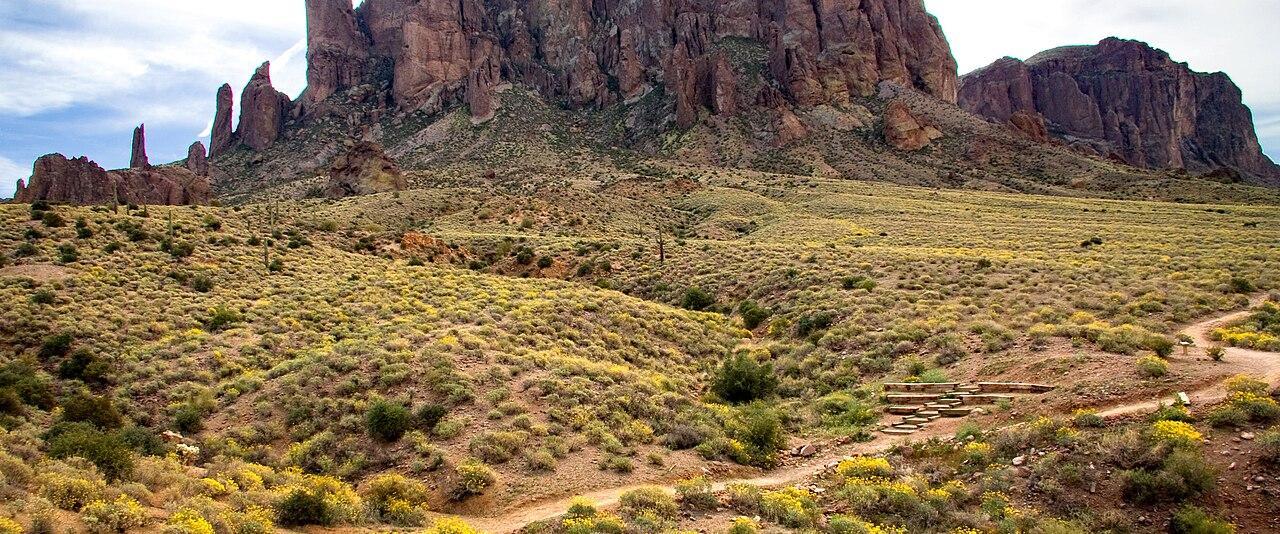
 Brittlebush in flower below the Superstition Mountains at Lost Dutchman State Park in March. Image: ksblack99, Public domain, via Wikimedia Commons.
Quick facts (checked November 2026)
- Low desert: first flowers in February, peak usually March. Organ Pipe Cactus National Monument gives February to mid-April.
- Picacho Peak State Park: best chance mid-February to mid-March, with weekly "Bloomdar" updates online. Entry $10 per car with one person, $20 with two to four.
- Higher elevations: around May, lasting into summer.
- Saguaro blossoms: late April to early June; Saguaro National Park says the peak is often toward the end of May.
- 2026-27 rain: NOAA's October 15 outlook leans wetter than normal for the Southwest for November to January. Nobody publishes a bloom forecast.
- Rules: stay on designated trails and never pick flowers (Arizona State Parks).
Why nobody can promise a good year
Desert annuals like poppies and lupine only come up in numbers after enough rain at the right time. The National Park Service at Saguaro National Park puts it plainly: a showy year needs "multiple seasons in a row of favorable conditions", and "there is no perfect way to predict any year's bloom for any one place." Picacho Peak's own page says the staff "cannot predict exactly when the best blooms will occur." At Organ Pipe, the park notes that the cool rains of mid-December through January bring "water for spring flowers", and that only exceptionally heavy winter rain produces a superbloom, when many species flower at once.
What is known in early November 2026:
- The NOAA Climate Prediction Center's El Niño discussion of October 8 says a strong to very strong El Niño is likely through January to March 2027, with a chance above 83 percent. It also says the effects of El Niño are more likely in a year like this, "though not guaranteed."
- The Center's seasonal outlook of October 15 gives an "elevated likelihood of above-normal seasonal precipitation" for much of California and the Southwest for November to January. A new outlook is due on November 19.
- A storm on November 1 flooded washes around Tucson and Superior; Boyce Thompson Arboretum recorded 2.62 inches of rain by 1 p.m. that day. One storm in November does not make a flower year.
Temperature matters too. Last season shows how. Picacho Peak logged more than 4 inches of rain between September 1, 2025 and January 5, 2026, and Arizona State Parks expected a good season. Then highs in the 80s in early February slowed the bloom, and by February 25 the park reported "Barren on flowers at this moment" with "very few poppies". Plan dates loosely and watch the reports from late January.
Timing by elevation
Arizona State Parks says desert blooms usually appear in this order: bladderpods, brittlebush, Mexican poppies, chuparosa, globemallow, then the cacti.
- Lowest desert, February to mid-April. Organ Pipe Cactus National Monument, near the Mexican border, says wildflowers start "as early as February" and continue through mid-April, while daytime temperatures climb into the mid-70s and 80s.
- Foothills near 3,000 feet, March to April. Saguaro National Park says its spring flowers are "often best mid-late March". Catalina State Park's trails sit near 3,000 feet, and Arizona State Parks says poppies there usually appear in March and April.
- Higher parks, around May. Arizona State Parks names Oracle State Park north of Tucson and Red Rock State Park in Sedona as places where flowers come later and last into summer. Red Rock State Park has been closed since the Oak Creek flood of November 1, 2026; see Sedona in winter for the latest.
- Cacti, April to June. Saguaro National Park says the first week of May has the greatest number of species in bloom there.
What you will see
The official park pages name the same handful of species again and again. The National Park Service at Organ Pipe lists the Mexican gold poppy, which flowers between February and April and, after a wet winter, "will blanket the landscape in gold." It is a desert form of the California poppy, and Arizona State Parks uses both names on its pages. The petals close at night and on cloudy days.
 A Mexican gold poppy photographed by Saguaro National Park staff. Image: SaguaroNPS, Public domain, via Wikimedia Commons.
Desert lupine, also called Coulter's lupine, adds spikes of blue-purple. Arizona State Parks says it grows below 4,500 feet in central and southern Arizona and flowers from March to May. Brittlebush is the yellow shrub that lines roadsides and hillsides, and globemallow brings orange to peach cups. Arizona State Parks notes that brittlebush and globemallow flower "even in drier years", so a weak poppy season still has some colour. One warning from the state's list: fiddleneck, a yellow-orange flower common after wet winters, "irritates human skin upon contact."
 Desert lupine in flower in the Arizona desert. Image: John Fowler from Placitas, NM, USA, CC BY 2.0, via Wikimedia Commons.
Picacho Peak State Park
Picacho Peak is the 1,500-foot peak beside Interstate 10 at Exit 219, between Phoenix and Tucson, and Arizona State Parks calls it one of the state's top wildflower destinations. The park names Coulter's lupine, California poppies and yellow palo verde trees, and says its best window is generally mid-February to mid-March. In February 2026 the park reported scattered poppies along the Nature Loop Trail and lupine lining the park roads.
Because so many people come, the park runs Bloomdar, a page with dated bloom notes and photos at azstateparks.com/bloomdar. In 2026 it carried a rain note on January 5 and then weekly updates through February. Arizona State Parks warns that at peak bloom you should plan for busy trails and longer waits to get in.
- Hours: park open 5 a.m. to 8 p.m. (gates close), trails sunrise to sunset; visitor center 8 a.m. to 5 p.m. until May 1.
- Entry: $10 per vehicle with one person, $20 with two to four, $5 on foot or bicycle.
- Guided hike: a park guide leads a hike to the summit on the Sunset Vista Trail on Saturday February 6, 2027, at 10 a.m.; registration required. It is a hard hike (6.2 miles round trip, steep cableways, about 4 hours), with no children under 10 and no dogs.
 Saguaros on the slopes of Picacho Peak State Park, seen outside the flower season. Image: dconvertini, CC BY-SA 2.0, via Wikimedia Commons.
Lost Dutchman State Park and the Superstitions
Lost Dutchman State Park sits at the base of the Superstition Mountains in Apache Junction, about 40 miles east of Phoenix. The park says that, "depending on the year's rainfall," you might see a carpet of desert wildflowers in spring. Arizona State Parks also shows red chuparosa blooming here. The easy option is the Native Plant Trail; the hard one is the Siphon Draw Trail up to the Flatiron.
 Spring flowers along a trail below the Superstition Mountains at Lost Dutchman State Park, March 2015. Image: Z Glyph, CC BY 3.0, via Wikimedia Commons.
Two practical points. Walk-in entry and hiker drop-offs are not permitted, so you need to drive in. The entrance station accepts only cash or a Visa or MasterCard with a readable magnetic stripe, with no tap or chip, and after hours the self-pay station needs exact change. Entry is $10 for one person in a car or $20 for two to four, and the day-use gates are locked from 8 p.m. to 6 a.m.
Boyce Thompson Arboretum near Superior
Boyce Thompson Arboretum is a botanical garden, not a wild bloom site, so it does not depend on one good rain year in the same way. The arboretum says it is about an hour's drive from central Phoenix and 30 minutes from Mesa on US 60, 3 miles from the town of Superior.
 Desert plantings and cacti along a path at Boyce Thompson Arboretum in March 2025. Image: Krzysztof Ziarnek, Kenraiz, CC BY-SA 4.0, via Wikimedia Commons.
- Hours: 8 a.m. to 5 p.m. daily from October through March; 7 a.m. to 5 p.m. in April; last entry one hour before closing.
- Admission: $24.95 for adults and ages 13 to 17, $10 for ages 5 to 12, free under 5 (as published in November 2026). Leashed pets are allowed.
- After the November flood: the arboretum closed early on November 1 and reopened the next day, with the Wallace Garden, the Demonstration Garden and parts of the Australian Garden closed for cleanup.
Catalina State Park and Saguaro National Park, Tucson
Catalina State Park, on North Oracle Road just north of Tucson, has nearly 5,000 saguaros at the foot of the Santa Catalina Mountains. Arizona State Parks says the Sutherland Trail is the easiest place there to find poppies, which usually appear in March and April, and in 2026 also pointed to the bases of the Nature and Alamo Canyon loops. The park reopened after the November 1 flood of the Cañada del Oro wash, but warns of eroded trails and water in the washes, and a wash-crossing project will bring construction vehicles to the main road until about May 2027. Entry is $10 to $20 per vehicle; the after-hours pay station is cash only.
 Poppies below saguaros in Catalina State Park in early March 2020. Image: Gillfoto, CC BY-SA 4.0, via Wikimedia Commons.
Saguaro National Park has two districts on either side of Tucson: the Tucson Mountain District to the west and the Rincon Mountain District to the east. The park is honest about its limits: its soils "are not suited to host large displays" of annual flowers, though most spring species turn up in a normal year, best in mid-to-late March. Its stronger season is the cactus bloom. A private vehicle pass costs $25 and is valid for seven days, and both visitor centers are open 9 a.m. to 5 p.m. until May 31.
Organ Pipe Cactus National Monument, near Ajo
Organ Pipe Cactus National Monument lies on Arizona Highway 85, 33 miles south of Ajo and about two and a half hours from Phoenix or Tucson. The monument says its wildflowers can start in February and continue through mid-April. The National Park Service lists Mexican gold poppy, desert lupine, purple owl's clover, globemallow and brittlebush, which it says is "especially common along roadsides."
 Brittlebush in flower around an organ pipe cactus in Organ Pipe Cactus National Monument. Image: NPS staff, Public domain, via Wikimedia Commons.
The 21-mile Ajo Mountain Drive is a one-way gravel and asphalt loop that takes one to two hours; vehicles over 25 feet are not allowed. Since August 24, 2026, roads near the border, including Grey's Ranch Road, Camino de Dos Republicas and the crossover roads south of South Puerto Blanco Drive, have been closed for border construction; South Puerto Blanco Drive itself is open. The monument is open 24 hours, and the vehicle fee is $25 for seven days. There is no public transport, and the nearest fuel is at Why and Lukeville.
Saguaro blossom season, May to June
When the annuals are over, the saguaros start. The National Park Service says that from late April through early June the tops of the trunks and arms produce "a profusion of large, creamy white flowers." Each flower opens at night and closes the following afternoon, and bats, birds and insects pollinate them, so morning is the time to look. Saguaro National Park says its saguaros are often at peak bloom toward the end of May. Organ Pipe adds that its namesake cactus also flowers in the same hot season.
 Saguaro blossoms near Tucson in late May. Image: Ken Bosma, CC BY 2.0, via Wikimedia Commons.
That timing comes with heat. Organ Pipe describes mid-April to mid-July as its hottest season, usually "well above 100F" by day. For summer, Saguaro National Park advises keeping outdoor activity to before 10 a.m. or after 4 p.m., and by late May that advice is worth following too.
Rules and how to check before you go
- Stay on trails and do not pick. Arizona State Parks asks visitors to "always stay on designated trails, never pick flowers, and follow park rules," and to be careful not to pick or trample the flowers.
- Check the official pages first. For Picacho Peak, use the Bloomdar page; for other state parks, azstateparks.com/Wildflowers. Arizona State Parks also says you can phone a park to ask what is in bloom. Organ Pipe's visitor center is on 520-387-6849.
- Treat secondary reports as hints. DesertUSA publishes a seasonal wildflower outlook; confirm anything it says with the park.
- Carry water and start early. Picacho Peak asks hikers to bring plenty of food and water and proper footwear. Organ Pipe says spring days climb into the mid-70s and 80s.
Practical notes
Getting there. From Phoenix, Lost Dutchman (Apache Junction) and Boyce Thompson (Superior, US 60) are the closest. Picacho Peak is at I-10 Exit 219 between Phoenix and Tucson. Catalina State Park is at 11570 N. Oracle Road on Tucson's north side. Organ Pipe is about two and a half hours from either city: Highway 86 west from Tucson, or Highway 85 south through Gila Bend and Ajo.
Fees and payment. State parks charge $10 to $20 per vehicle; after-hours pay stations at Lost Dutchman and Catalina take exact cash only. National park passes at Saguaro and Organ Pipe are $25 per vehicle for seven days.
Weekends. At peak bloom the state parks get busy, Picacho in particular. Go on a weekday or arrive when the gates open.
Hours, fees and conditions are as published by the parks in November 2026, and can change before spring.