Flagstaff sits at about 7,000 feet, and in winter that height decides almost everything. Arizona Snowbowl is scheduled to open its 2026-27 season on Friday, November 20, 2026, and the free Mountain Express bus from downtown runs daily from December 26, 2026 to January 3, 2027, then on weekends through February 28. Average December nights at the airport drop to about 17 °F, and a normal winter brings around 60 inches of snow between December and February. Cross-country trails, a tubing park, Lowell Observatory and the Polar Express in Williams fill the rest of a winter trip.
Quick facts (checked November 7, 2026)
- Arizona Snowbowl: scheduled opening day Friday, November 20, 2026, weather permitting. Lifts normally run 9 a.m. to 4 p.m. Ticket prices change with demand and are lower when bought online in advance.
- Free ski bus: Mountain Express, every 20 minutes, 7:30 a.m. to 5:30 p.m. on service days. Daily December 26 to January 3, then Saturdays and Sundays until February 28, 2027. Free parking at Flagstaff High School.
- US 180 shoulders: no parking. The Arizona Department of Public Safety does not allow parking along the highway; park only in plowed, signed lots.
- Lowell Observatory: open noon to 10 p.m., closed Tuesdays and on Thanksgiving, Christmas Eve, Christmas Day and New Year's Day.
- Polar Express: leaves Williams nightly at 5:30 and 7:30 p.m. on select dates from early November to late December. About 90 minutes.
- Road conditions: az511.gov or dial 511.
Cold nights at 7,000 feet
Flagstaff's NOAA weather station at Pulliam Airport stands at almost exactly 7,000 feet. NOAA's 1991–2020 normals there give a December average high of 43 °F and an average low of 16.9 °F. January is almost the same, 43.4 °F and 17.6 °F. February is a little milder, 45.7 °F and 19.6 °F.
Snow is normal, not a freak event. The same record gives normal snowfall of 18.5 inches in December, 20.9 inches in January and 19.3 inches in February, and about 90 inches across a full year. The heaviest month on record was 86 inches in December 1967. Sunny afternoons are common, but a clear night after a storm is when the coldest readings come. Pack for both: a warm coat, a hat and gloves for the evening, and waterproof boots for slush in town.
If you are driving up from Phoenix on I-17, the change is sharp: you can leave warm desert weather and arrive to snow on the ground and temperatures below freezing after dark.
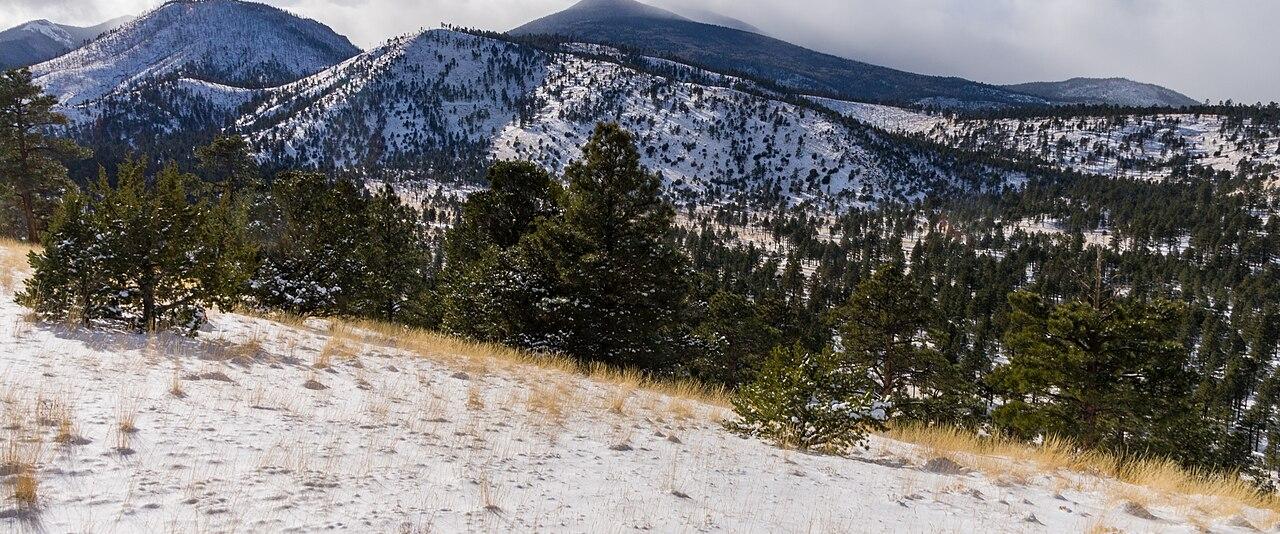
 The San Francisco Peaks after the Christmas Eve storm of 2016, seen from the Coconino National Forest northeast of the mountain. Image: Forest Service Photography, Public domain, via Wikimedia Commons.
Arizona Snowbowl in 2026-27
Arizona Snowbowl is on the western slopes of the San Francisco Peaks, about a 30-minute drive north of downtown on US 180 and Snowbowl Road. Visit Flagstaff says it opened in 1938 and calls it one of the oldest continually run ski areas in the United States. It lists 61 runs, a lift-served elevation of 11,500 feet, a vertical drop of 2,300 feet and average snowfall of 260 inches. The resort's own lift board counts nine lifts, including the Arizona Gondola and the Grand Canyon Express six-person chair.
The resort announced in August that it is "scheduled to open November 20, 2026," and says opening depends on the weather. New for this season is a 150-foot conveyor lift on the beginner terrain. Last season it opened daily on November 21, 2025, and ran until a closing weekend on April 11 and 12, 2026.
Tickets. Snowbowl uses demand pricing: "Our ticket prices change based on demand," and the earlier you buy online, the lower the price. A 2026-27 price table was not posted on its lift-ticket page in early November. For comparison, at the start of last season the resort advertised lift tickets "for as low as $19" online and in advance. Expect to pay much more on holiday weekends.
The gondola for non-skiers. The gondola is mostly sold as a summer and autumn ride, but on its April 2026 closing weekend Snowbowl listed "Winter Scenic Gondola Rides (12 PM – 4 PM)." The hours page lists scenic rides as "scheduled to open November 20, 2026," without winter times or prices. Call 928-447-9928 before you plan a ride-only visit.
 Skiers waiting at a lift at Arizona Snowbowl in December 2008. Image: Frederick Dennstedt from los angeles, usa, CC BY-SA 2.0, via Wikimedia Commons.
Parking. The resort has two base areas: Hart Prairie (lots 1 to 4) for beginners and Agassiz (lots 5 to 8) for intermediate and advanced skiers. "Parking is NOT permitted along Snowbowl Road." After storms the road may require four-wheel drive or chains. On those days Fort Valley Lodge, at the bottom of Snowbowl Road, works as a shuttle pickup, and the lodge is open daily from 10 a.m. to 5 p.m.
The free bus. The Mountain Express, run by Mountain Line, is the simplest way up on busy days. It leaves the Downtown Connection Center every 20 minutes from 7:30 a.m., stops at the Flagstaff High School Park-n-Ride (free parking), and runs to Hart Prairie Lodge; the last bus leaves at 5:30 p.m. In 2026-27 it runs every day from December 26 to January 3, then Saturdays and Sundays in January and February until February 28.
Cross-country skiing and snowshoeing
Arizona Nordic Village is the main groomed cross-country area. It runs under a Forest Service special use permit, about 15 miles northwest of Flagstaff, with parking at mile marker 232 on US 180. Visit Flagstaff lists an average elevation of 8,300 feet, 25 miles (40 km) of groomed trails for classic and skate skiing and 10 miles (15 km) of snowshoe trails. It rents classic and skate skis, snowshoes and pulk sleds for towing small children. Day, multi-day and season passes are needed on the trails. The village had not posted 2026-27 opening dates or pass prices by early November, so check before you drive. There is a small snow play area by the main parking lot, but the old sledding hill nearby is gone.
Closer to town, Buffalo Park in Flagstaff is used for cross-country skiing and snowshoeing after a storm. Sledding is not allowed there or in any other city park.
 Fresh snow near Buffalo Park in Flagstaff, December 2009. Image: Deborah Lee Soltesz, CC0, via Wikimedia Commons.
Further up US 180, the Coconino National Forest keeps Peak View, about 6.5 miles north of Flagstaff, and Walker Lake, at marker 235, as winter parking areas for snowshoeing and skiing. The lots are small and are plowed only when ADOT has crews free. On a busy weekend they fill early.
Snow play: where it is allowed and where it costs you
On snowy weekends many day-trippers drive up US 180 looking for somewhere to sled. Know the rules before you load the car.
- Flagstaff Snow Park at Fort Tuthill County Park (2446 Fort Tuthill Loop, just south of town) has six tubing runs and a kiddie hill. Tickets are sold only online, up to five days ahead, as three-hour, full-day or night sessions, and each visitor also needs a signed online waiver. Tubes are provided and your own sleds are not allowed. Last season it opened on December 20, 2025; for 2026-27 the park's website gives a scheduled opening day of December 12, depending on snow.
- Fort Tuthill County Park itself allows free snow play from dawn to dusk.
- No snow play at Snowbowl. Sledding, tubing and building snowmen are not allowed in the ski area or along Snowbowl Road.
- No parking on the US 180 shoulders. Visit Flagstaff says the Arizona Department of Public Safety does not allow parking along the highway at Peak View "or at any other location." Park only in plowed, signed lots.
- Closed: Visit Flagstaff lists the old Wing Mountain and Crowley Pit snowplay areas as permanently closed.
- Take your trash home, including broken sleds. Littering is illegal and Forest Service rangers enforce it.
For directions to the snow play areas, call 1-844-256-SNOW (7669).
Lowell Observatory in winter
Lowell Observatory sits on Mars Hill at 7,250 feet, a short drive west of downtown. The observatory calls itself the home of Pluto's discovery. Hours are noon to 10 p.m., every day except Tuesday. It is closed on Thanksgiving, Christmas Eve, Christmas Day and New Year's Day. General admission does not need a reservation. The observatory lists viewing of the historic Clark Telescope, solar viewing and stargazing at the Giovale Open Deck Observatory, with six telescopes, as included in admission. A rooftop Dark Sky Planetarium show is a $5 add-on.
 The Clark Telescope dome at Lowell Observatory on Mars Hill, May 2011. Image: brewbooks from near Seattle, USA, CC BY-SA 2.0, via Wikimedia Commons.
Winter changes the visit in two ways. Darkness comes early in December, so you can see stars well before dinner. And the open deck is outside, at 7,250 feet, on nights that often drop into the teens. Dress as you would for skiing. Cloudy nights limit telescope viewing, so check the forecast and call 928-774-3358 if you are unsure. The observatory holds its Pluto Festival every February.
Flagstaff, the first Dark Sky City
On October 24, 2001, the International Dark-Sky Association named Flagstaff the world's first International Dark Sky City. In 2016 the three national monuments around Flagstaff, Walnut Canyon, Sunset Crater Volcano and Wupatki, were designated together as an International Dark Sky Park. Long winter nights give you the most dark hours of the year, but check that roads and parking are open after snow before you drive out.
 Star trails and blowing snow over Humphreys Peak, photographed from US 180 in January 2009. Image: JohnIngraham, CC BY-SA 3.0, via Wikimedia Commons.
The Polar Express from Williams
Williams is about 30 miles west of Flagstaff on Interstate 40 (Exit 163). The Grand Canyon Railway runs its Polar Express from the depot there, which stands behind the Grand Canyon Railway Hotel. It runs on "select dates from early November through late December," with departures nightly at 5:30 and 7:30 p.m. The round trip takes about 90 minutes. Riders get hot chocolate and a cookie while the story is read, and Santa meets the train at "the North Pole." Pajamas are encouraged.
The railway publishes its 2026 dates and rates only on a booking calendar, so check thetrain.com or call 1-888-848-3511 for the price on your night. Bookings made on or after August 10, 2026 are fully refundable up to 14 days before departure, and 50% refundable after that. The railway asks passengers to arrive at least an hour and a half before departure. Boarding starts 15 minutes before, and parking around the hotel and depot is free. Allow time to walk the Williams historic district along Route 66 before your train.
 A Grand Canyon Railway diesel locomotive in snow, December 2013. Image: Keith Yahl, CC BY 2.0, via Wikimedia Commons.
If you want to see the Grand Canyon in snow as well, the railway's daytime train runs to the South Rim; details of the park in winter, including lodging and closures, are in Grand Canyon in winter 2026-27.
Driving I-17 and I-40 in snow
Most visitors arrive on Interstate 17 from Phoenix or Interstate 40 from the east or west. Both climb to around 7,000 feet near Flagstaff, and both can close during winter storms. Before every winter drive, check az511.gov or dial 511 for closures, crashes and road cameras. Carry water, snacks, blankets and a charged phone, and give snowplows plenty of room.
Our winter driving and road conditions guide covers chains, closures and what to do if you are stuck on the road.
 A passenger train arriving in Flagstaff in the snow on Christmas Day 2008. Image: Rod Ramsey, CC BY 2.0, via Wikimedia Commons.
Practical notes
- Getting there: Flagstaff is on I-17 and I-40. Williams is about 30 miles west on I-40. Snowbowl is about 30 minutes north of downtown on US 180 and Snowbowl Road.
- Parking: no parking on US 180 shoulders or along Snowbowl Road. Use the Snowbowl lots, the free Park-n-Ride at Flagstaff High School, or signed Forest Service lots.
- Ski bus: free, daily December 26, 2026 to January 3, 2027, then weekends to February 28.
- Reservations: Flagstaff Snow Park tickets online only, up to 5 days ahead. Polar Express December dates are best booked early.
- Conditions: az511.gov or 511 for roads; 1-844-256-SNOW for snow play; snowbowl.ski for lifts and the shuttle.
- Season dates: Snowbowl's November 20 opening, the snow park's opening and the Nordic Village's opening all depend on snow.
Dates, hours and prices here are as Arizona Snowbowl, Visit Flagstaff, the Coconino National Forest, Lowell Observatory and the Grand Canyon Railway published them in November 2026.